Friday, September 20, 2013

New Single-Family Home Size Rises

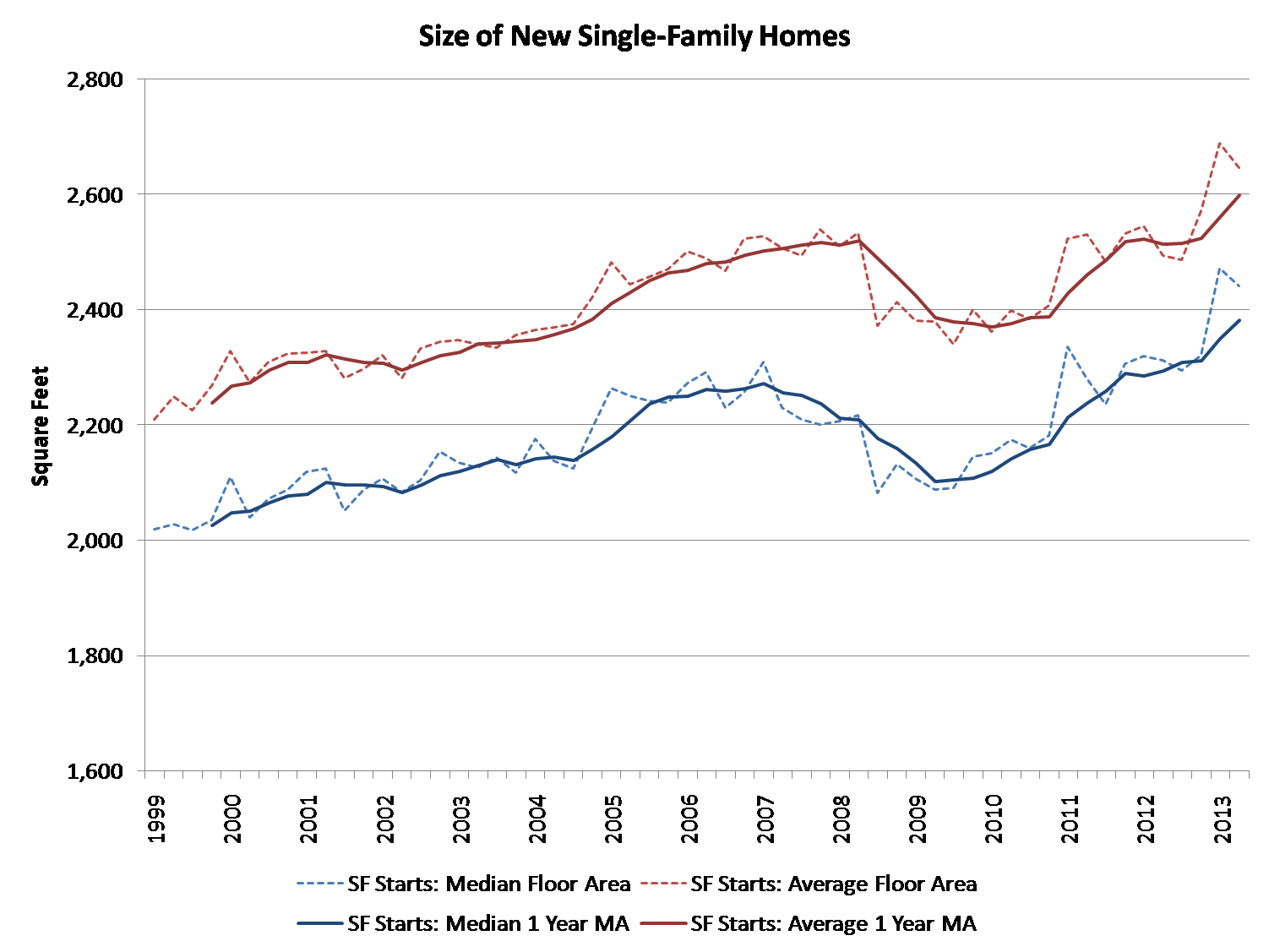
The size of a typical new single-family home rose in second quarter of 2013 continuing a post-recession trend. The recent increase in size is likely due to an atypical mix of buyers.

According to data from the Census the Quarterly Starts and Completions by Purpose and Design survey, the average and median size of single-family homes started during the second quarter actually fell somewhat from the first quarter. The average single-family square footage fell from 2,689 to 2,647, while the median declined from 2,472 to 2,441.

SF size 
 
However, on a less volatile one-year moving average, the size of new single-family homes continued their rising trend. Since cycle lows and on a moving average basis, the average size has increased almost 10% to 2,599, while the median size has increased more than 13% to 2,382.
As noted in NAHB’s analysis of 2012 Census construction data, the recent rise in single-family home sizes is consistent with the historical pattern coming out of recessions. Home sizes fall into the recession as some homebuyers cut back, and then sizes rise as high-end home buyers, who face fewer credit constraints, return to the housing market in relatively greater proportions.


Thursday, September 19, 2013

Divorce and Home Values: Till Equity Do Us Part

h
Many unhappy couples are now calling it quits, local divorce attorneys and real-estate agents say, for one simple reason: Home prices have been rising, which means they can finally get some start-over cash out of houses that used to be underwater.

“So many couples have been living together and biding their time,” Orlando lawyer Leigh Sigman said. “I know many people who have coasted for years and touched base with me periodically — until they got equity in their homes.”

Before the 2007-09 recession, couples who divorced vied first for the children and then for the real-estate assets, Sigman said. But once the economic downturn stripped houses of half their value, the one-time happy abode became the hot potato that no one wanted in a divorce because it came with a mountain of mortgage debt — “worse than credit cards,” Sigman said.

For better, for worse — or at least until the house can sell for a profit?
Exactly how the housing market might be affecting the divorce rate is uncertain. In Orange County, divorces were on the downslide from 2007 to 2008, heading into the recession, but the per-capita rates for the county have increased since then. Meanwhile, home values have had a bumpy ride over the same stretch, bottoming out in 2011 before rallying in the past 21/2 years.

Local lawyers and real-estate agents say what’s happening is obvious: After years of slumping business, things have picked up now that home values have improved.
Stan Humphries, chief economist for a Seattle-based real-estate-research firm, says a decrease in the percentage of underwater homes has allowed more homeowners to sell at a profit, so they can finally relocate to other parts of the country, and has allowed more couples to make marital decisions without worrying about a distress sale ruining their credit.

“They can now sell, liquidate their assets and go their separate ways,” says Humphries, who was in Orlando this week meeting with groups of real-estate agents.
The number of “underwater” homes — properties worth less than their mortgage balance — has declined in four-county Metro Orlando from 54 percent of all mortgaged houses in the fall of 2011 to 41 percent as of July of this year.

Some real-estate agents say the drop in homes with negative equity has spurred their business with both divorcing couples and divorcees.
Orlando real-estate agent Robert Tenaglia says he was recently at a REALTOR® function when an agent commented to a small group: If it wasn’t for divorce, I’d have no business now.

“I have seen many of the deals we’re doing have involved a divorce — selling a house because of it or buying because of it,” says Tenaglia. “When people don’t have equity and don’t have money, it dissuades them from going through the final step.”

Getting even a little equity out of a house sale helps cover what can be some pretty hefty costs to get restarted with a new down payment or apartment deposits, Tenaglia says. Even though it’s an unhappy time for couples, the formation of new households helps spur the local economy as newly single consumers purchase furniture, utilities and other services, he added.

Home-sale profits may not be the only real-estate transaction affecting a couple’s relationships.
Orlando resident Debbie March says that she was able to transition out of a marriage that no longer made sense when Bank of America agreed to modify her monthly mortgage payment from a high of $2,200 a month to about $1,400, which was an amount she could begin to afford on her own.
“I got it modified on my own, without him,” says March, who is in the process of ending her marriage. “It’s time now.”

Orlando lawyer Justin Clark said the main issue is that couples sometimes stay together simply because they don’t have enough money to leave each other.
“In the past, you could count on money from a sale to help you start over,” he says.


Wednesday, September 18, 2013

8.3 Million Underwater Homeowners On Track To Resurface Before 2015

While 10.7 million residential homeowners nationwide owe at least 25 percent or more on their mortgages than their properties are worth, another 8.3 million homeowners are either slightly underwater or slightly above water, putting them on track to have enough equity to sell sometime in the next 15 months — without resorting to a short sale.

The 8.3 million include homeowners with a loan to value (LTV) ratio from 90 to 110 percent, meaning they have between 10 percent positive equity and 10 percent negative equity. These homeowners represented 18 percent of all U.S. homeowners with a mortgage as of the beginning of September.

The 10.7 million residential properties with an LTV ratio of at least 125 percent represented 23 percent of U.S. residential properties with a mortgage — down from 11.3 million deeply underwater properties representing 26 percent of all residential properties with a mortgage in May 2013 and down from 12.5 million deeply underwater properties representing 28 percent of all residential properties with a mortgage in September 2012.

“Steadily rising home prices are lifting all boats in this housing market and should spill over into more inventory of homes for sale in the coming months,” says Daren Blomquist, vice president at RealtyTrac. “Homeowners who already have ample equity are quickly building on that equity, while the 8.3 million homeowners on the fence with little or no equity are on track to regain enough equity to sell before 2015 if home prices continue to increase at the rate of 1.33 percent per month that they have since bottoming out in March 2012.”

“In addition, nearly one in four homeowners in foreclosure has at least some equity, giving them a better chance to avoid foreclosure without resorting to a short sale — assuming they realize they have equity and don’t miss the opportunity to leverage that equity,” Blomquist added. “Even homeowners deeply underwater have reason for hope, with about 150,000 each month rising past the 25 percent negative equity milestone — although it will certainly take years rather than months before most of those homeowners have enough equity to sell other than via short sale.”

Other high-level findings from the report:

• More than 126,000 properties in the foreclosure process nationwide had an LTV of 100 percent or lower in September, representing 24 percent of all homes in the foreclosure process. States with the highest percentage of foreclosures with equity included Oklahoma (54 percent), Hawaii (51 percent), New York (47 percent), and Texas (46 percent).

• States with the highest percentage of deeply underwater homes (LTV of 125 percent or higher) included Nevada (46 percent), Illinois (40 percent), Florida (40 percent), Michigan (38 percent), Rhode Island (34 percent), and Ohio (31 percent).

• Metro markets with the highest percentage of homes with resurfacing equity (LTV from 90 to 110 percent) included Omaha, Neb., (29 percent), Colorado Springs, Colo., (29 percent), Tulsa, Okla., (29 percent), Little Rock, Ark., (28 percent), and Raleigh, N.C. (28 percent).

• Nationwide 7.4 million homeowners with a mortgage had 50 percent equity or more, representing 16 percent of all homeowners with a mortgage. Metro markets with the highest percentage of homeowners with at least 50 percent equity included Honolulu (36 percent), San Jose, Calif., (35 percent), Poughkeepsie, N.Y. (30 percent), Pittsburgh (29 percent), San Francisco (29 percent), and New York (27 percent).


Tuesday, September 10, 2013

Life without Fannie Mae and Freddie Mac?

Life Without Fannie Mae and Freddie Mac


The New York Times

Talk of doing away with Fannie Mae and Freddie Mac is still just that — talk. But as Congress considers whether and how to get rid of these agencies, consumers ought to be aware of how a substantial reduction in the government’s role in housing finance could affect their ability to borrow in the future. 

“What’s at stake here is access to mortgages at an affordable price,” said Julia Gordon, the director of housing finance and policy at the Center for American Progress in Washington.
Fannie and Freddie have been much maligned since their heavy investment in risky loans resulted in a $188-billion taxpayer bailout during the financial crisis. Having since refocused on guaranteeing and securitizing prime mortgages, while also acting as a fill-in for fleeing private capital, the agencies now own or guarantee a majority of the country’s home loans.
As the housing market strengthens, Congress is interested in transferring some or all of that risk back to the private sector. Last month, President Obama voiced support for a bipartisan effort in the Senate to replace the government-sponsored agencies with a new agency with a much-reduced role.
A competing bill in the House would go even further to almost completely privatize the mortgage market.
If a winding down of the two agencies is inevitable, some government guarantee should remain to ensure lending is widely available and safe, Ms. Gordon said.
“The private market likes to look at every single loan — they only want the loans that are the crème de la crème,” she said. “If you scale back the government guarantee too much, then you end up with a really segmented market where people who have pristine credit scores and lots of money can get good, safe, well-priced mortgages, but everybody else can’t.”
A former administrator at the Federal Housing Finance Agency, Ms. Gordon cited analyses that estimate a half-percentage-point rise in borrowing costs if a “fairly robust” government guarantee stays in place, and an increase of at least a whole percentage point if it is dropped completely. The reason for the added expense is that “the market is going to perceive greater risk associated with the loans,” said Alan MacEachin, the corporate economist for the Navy Federal Credit Union, a four million-member banking institution in Virginia. “If there’s greater risk, the markets have to be compensated, and that compensation is higher interest rates, or risk premiums, if you will.”
With a greatly reduced government backstop, borrowers would likely have to contend with higher down payment requirements, Mr. MacEachin said. And, he added, “lending conditions would be more reactionary to what’s going on in the market. We could only imagine what could have happened had the government not stepped in during the mortgage crisis.”
Any reform isn’t likely to happen for at least a couple of years, especially since the now-profitable agencies are repaying the government for the bailout “rather handsomely,” Mr. MacEachin said.
Despite widespread negative perceptions of Fannie and Freddie, the conversations about reform have, in a “refreshing twist,” drawn attention to the positive role the agencies play, noted Alex Matjanec, a founder of MyBankTracker.com, a personal finance Web site.
A central argument for eliminating Fannie and Freddie is to get taxpayers off the hook for any further bailouts. But Mr. Matjanec thinks that professed taxpayer protection may be false assurance.
“If a major bank fails,” he said, “I think the government will treat them like a General Motors and bail them out anyway.”


Monday, June 3, 2013

Seven Costly Mistakes Sellers Make

There are always appropriate steps to investing in real estate and hopefully, you've garnered many of them right on these pages. However, there are also inappropriate steps sellers can walk down when it comes time to put their house on the market.
For instance, the seller in Virginia, who thought the half bath the builder had located at the front of the house would really be better situated toward the back of the main level (though all the other similar models had the powder room in the same place for the previous 20 years). He got hung up on this detail so much, that he just had to move it -- and did -- for thousands of dollars, just so he could get it on the market the "right way." His hang-up may have settled some deep-seated emotional need for him, but it didn't draw any more buyers, and it drained his bottom line. You might say, that was a costly mistake.
Real estate broker and author Sid Davis has identified in his book "A Survival Guide to Selling a Home," another seven costly mistakes that many sellers make when it comes time to put their home on the market. In my business, I've seen each one of these mistakes played out and it just makes me shake my head as to why, sellers forge ahead with unwise strategies, instead of listening to the voice of an experienced professional.
The seven costly mistakes
Mistake 1: Putting the home on the market before it's ready. Most times this happens because the seller gets impatient or is a procrastinator and has pushed himself up against a moving deadline without getting the pre-sale work done. So it comes on the market with the horrible carpet (that gets replaced during the marketing of the home); or they are painting it while it goes on the market. Presentation is everything -- so get the work done before marketing the property.
Mistake 2: Over improving the home for the neighborhood. This happens with additions, bump outs, and upgrades that make the home stick out from among its competitors so much that it's an anomaly, instead of a nice addition to the community.
Mistake 3: Pricing the home based on what the seller wants to net. This pricing strategy always ends in failure. Sellers can control the "asking" price, but they don't control the "sales" price. The market does. It doesn't matter what the seller wants, the price is determined by the black-and-white, matter-of-fact reality of the market.
Mistake 4: Hiring an agent based on non-business factors. Make sure you're hiring a professional with a proven track record. It might be nice to hand over your largest asset to your nephew who just got his license -- but make sure he has a mentor to keep your deal from going south.
Mistake 5: Getting emotionally involved in the sale of the home. This is one of the biggest challenges home sellers face when putting their house on the market. Once you decide to sell your house, it's no longer a home, but a commodity. It needs to be prepared as a commodity, marketed as a commodity, and priced as a commodity. It doesn't matter what you "want," only what the market can bear on pricing. People are going to come in to kick the tires, so to speak, and you can't get emotional about how they may or may not appreciate the nuances of your home of seven years.
Mistake 6: Trying to cover up problems, or not disclosing them. Most states have a property disclosure/disclaimer form -- use it wisely. Just because you disclaim doesn't mean you cannot be sued later for the leaky basement, or dilapidated heating/air system that's discovered 30 days after settlement.
Mistake 7: Not getting your ducks lined up before trying to sell. This would involve financing, reading the fine print on your current mortgage to ensure no pre-payment penalties, not listening to the particulars of your local market, etc. If your local market is dictating lower home prices, then lower it early, not later -- it will cost you more. If the local market dictates selling your home first, then buying second, do it in that order, or vice versa.
Avoiding these mistakes is not that difficult. There are plenty of resources (like this publication) and professionals, who are there to help you step over the pitfalls. Do the research early, and listen to that voice in your head (it's probably the whispers of the finance, real estate, insurance person who's warning you of a hole you're about to step into). Sell well.
 

Friday, May 31, 2013

Mortgage Rates Continue Upward Trend

Freddie Mac recently released the results of its Primary Mortgage Market Survey(R) (PMMS®), showing fixed mortgage rates trending higher for the third consecutive week and putting pressure on refinance momentum. Regardless, mortgage rates remain low helping to keep home-buyer affordability high, which should further aid home sales and construction in coming weeks.

The survey showed that the 30-year fixed-rate mortgage (FRM) averaged 3.59 percent with an average 0.7 point for the week ending May 23, 2013, up from last week when it averaged 3.51 percent. Last year at this time, the 30-year FRM averaged 3.78 percent.

Additionally, the 15-year FRM this week averaged 2.77 percent with an average 0.7 point, up from last week when it averaged 2.69 percent. A year ago at this time, the 15-year FRM averaged 3.04 percent.

The 5-year Treasury-indexed hybrid adjustable-rate mortgage (ARM) averaged 2.63 percent this week with an average 0.5 point, up from last week when it averaged 2.62 percent. A year ago, the 5-year ARM averaged 2.83 percent.

The 1-year Treasury-indexed ARM averaged 2.55 percent this week with an average 0.4 point, the same as last week. At this time last year, the 1-year ARM averaged 2.75 percent.

Average commitment rates should be reported along with average fees and points to reflect the total upfront cost of obtaining the mortgage. Visit the following links for the Regional and National Mortgage Rate Details and Definitions. Borrowers may still pay closing costs which are not included in the survey.

"Fixed-rates moved up for the third consecutive week, with the average 30-year fixed-rate mortgage about a quarter-percentage point higher than three weeks ago,” says Frank Nothaft, vice president and chief economist, Freddie Mac. “While this may slow some of the refinance momentum, rates are nonetheless low and home-buyer affordability high, which should further aid home sales and construction in coming weeks. For instance, in April, single family housing permits rose to the strongest pace since May 2008 while existing home sales for the same month grew the most since November 2009. Moreover, the National Association of REALTORS® reported that the median number of days on the market for these sales fell from 62 to 46 days, the fewest since it began collecting the data in May 2011."

For more information, visit www.FreddieMac.com.
Reprinted with permission from RISMedia. ©2013. All rights reserved.

Tuesday, May 21, 2013

Host an Extraordinary Outdoor Bash

Family Features—What do you get when you combine great food, good company and a beautifully set table? One truly memorable party.
No matter what the reason for the gathering, find your inspiration from the splendor found outdoors. Picture a rustic table set under the olive trees in the Italian countryside or warm, gentle breezes rustling through a gorgeous garden in the South of France. Nature draws you in, invites you to sit down and encourages you to savor special moments.
Create the same experience for your guests at your home. Set a wooden table under shaded trees or a covered patio then gather several chairs around. Keep decorations simple and let the natural elements set the mood.
There is something about flowers that instantly makes any gathering feel special. Place several large sunflowers into a vase for the center of the table—or trim the stems off your favorite blooms and float them in a large serving bowl. For another simple centerpiece, line several glasses or small bowls down the center of the table and place a single blossom in each. No flower arranging skills required.
Here are few more easy tips to make your next outdoor party a charming and memorable event:
  • Choose music that is light and uplifting. Make sure it isn't so loud that guests can't carry a conversation.
  • If you use a tablecloth or runner, strategically place small bowls or serving pieces around the table to keep the cloth secure.
  • Slip sprigs of green inside the folds of the napkins for a decorative touch. Tuck flatware inside the napkins to help keep the linens from blowing off the table.
  • Mix earthy elements into the table decor. Make your party a winner, naturally, by adding pinecones, moss, or small flowers to decorative bowls.
  • Select several smooth stones and write each guest's name on them. These organically chic place cards make a memorable party favor.
  • Serve a signature drink named after the theme or celebration of the party.
  • Place votive candles in clear containers or glasses for a casual, romantic glow.
  • The secret to great entertaining is keeping things simple. Parties should be uncomplicated, easy and just as much fun for the hosts as it is for the guests. Start with a simple menu and then get everyone outdoors to enjoy the splendor of warm breezes, lush trees and colorful flowers.
Source: www.Pfaltzgraff.com.